What if a sports car could do more than race on the road? Tesla has offered a glimpse of that possibility with its latest Roadster demonstration, featuring a vehicle that briefly lifted off the ground, rotated in mid-air and landed back on its wheels. The showcase has renewed interest in Elon Musk’s long-promised vision of a flying car.
The demonstration took place on October 15, 2026, at a SpaceX test facility in Texas. Tesla presented its next-generation Roadster with technology developed in collaboration with SpaceX, including cold-gas thrusters designed to deliver additional thrust for specialised manoeuvres.
However, there is an important distinction between a car that can briefly leave the ground and one capable of flying over long distances. Although Tesla’s demonstration was dramatic, several questions about safety, road legality, pricing and commercial availability remain unanswered.
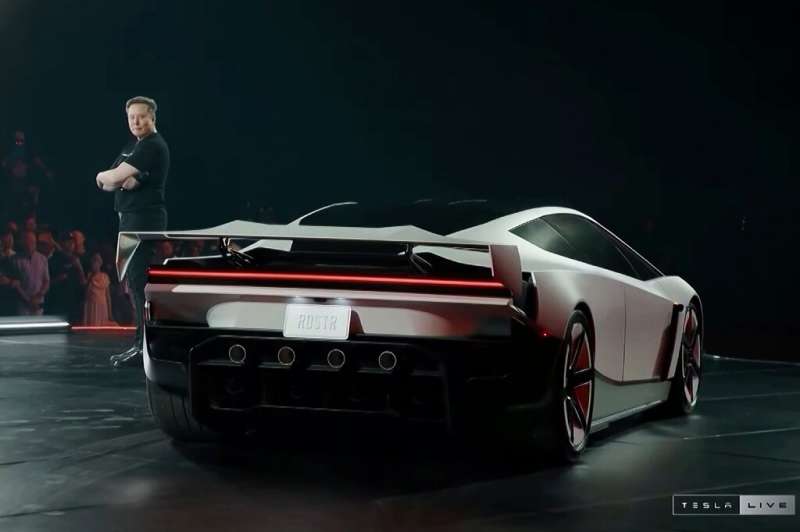
Tesla Roadster Demonstration: What Happened in Texas?
The event gave audiences their first look at the redesigned Roadster performing a series of unusual manoeuvres. In one demonstration, the vehicle travelled up a curved ramp and remained upside down with the help of a specialised suction system. It then performed an aerial rotation before returning to the ground.
Another part of the showcase involved the vehicle jumping over a line of Tesla models. The car was demonstrated without a human occupant, with Musk explaining that remote operation was used to avoid putting anyone at risk during the stunt.
The demonstration was intended to highlight how electric vehicle engineering and aerospace technology could work together. While the Roadster remains a sports car in its basic design, its experimental propulsion system introduces capabilities that go beyond those of conventional performance vehicles.
Tesla has not yet established that these airborne manoeuvres can be performed safely under ordinary driving conditions or repeated as part of everyday transportation.
How Does Tesla’s Flying Car Technology Work?
The redesigned Roadster combines conventional electric vehicle technology with systems inspired by aerospace engineering. Two features are particularly important to its demonstration.
1. Cold-Gas Rocket Thrusters
The vehicle uses cold-gas thrusters developed with SpaceX. These systems release pressurised gas through nozzles to generate thrust, allowing the vehicle to perform specific movements that cannot be achieved through tyre grip alone.
Tesla has presented the thrusters as a way to improve acceleration and enable brief airborne manoeuvres. The system is also intended to help control the vehicle’s orientation during specialised demonstrations.
Despite the rocket-inspired technology, the Roadster should not be confused with a conventional aircraft. Publicly available information does not yet establish how high it can fly, how long it can remain airborne or how far it can travel in the air.
2. A Specialised Suction System
Another unusual feature is the system that allows the Roadster to travel upside down along a purpose-built track.
The system uses fans and suction beneath the vehicle to generate additional downforce, helping it remain attached to the curved surface during the demonstration.
This technology is different from the thrusters. The suction system helps keep the vehicle against the track, while the thrusters provide propulsion for specialised movements.
Together, these features demonstrate Tesla’s attempt to push the boundaries of vehicle performance. However, their effectiveness and reliability in everyday driving environments will require further testing.
Tesla Roadster Performance: How Fast Can It Go?
Speed is another major part of the Roadster’s appeal. Tesla has claimed that the vehicle can accelerate from zero to 60 miles per hour in less than one second. During the unveiling, the company cited a figure of approximately 0.81 seconds.
The manufacturer has also previously discussed a top speed exceeding 250 mph and a driving range of around 620 miles for the next-generation model. These figures should be treated as announced targets or company claims until the final production specifications and independent test results are available.
If Tesla achieves its acceleration target in a production vehicle, the Roadster could compete with some of the world’s most extreme performance cars.
However, acceleration, top speed, battery range and airborne performance are separate capabilities. A successful short flight demonstration does not automatically establish the vehicle’s real-world range, efficiency or handling characteristics.
When Will the Tesla Flying Roadster Be Available?
Tesla has announced 2028 as the target for beginning production of the next-generation Roadster.
The project has experienced a lengthy development period. Musk first introduced the new Roadster in 2017, with production originally expected to begin in 2020. Subsequent delays pushed the anticipated launch back several times.
The October 2026 demonstration represents a significant public milestone, but it does not mean that customer deliveries are imminent.
Tesla will still need to finalise production specifications, manufacturing plans and the regulatory requirements applicable to the different vehicle configurations. The actual delivery schedule may depend on how these steps progress.
For prospective buyers, 2028 remains a target rather than a guarantee of when the vehicle will be available.
How Much Will Tesla’s Flying Roadster Cost?
A final confirmed selling price for the redesigned Roadster has not been established.
When Tesla first announced the next-generation model in 2017, it discussed a starting price of approximately $200,000. That original figure should not automatically be treated as the final price of the newly demonstrated vehicle.
Tesla has also presented different configurations with different equipment and capabilities, including versions featuring thrusters. Reservation requirements and final purchase prices are not the same thing, so prospective customers should check the company’s latest official terms before making a financial commitment.
The more experimental versions could have different availability restrictions from the standard performance model. The final price, delivery terms and production quantities remain important details to watch as the launch approaches.
Will Tesla’s Flying Car Be Legal on Public Roads?
This is one of the biggest questions surrounding the Roadster.
A conventional electric sports car must meet applicable vehicle safety and roadworthiness requirements. A vehicle equipped with a system that can propel it into the air introduces additional engineering and regulatory challenges.
Tesla’s demonstration does not establish that the airborne features are approved for unrestricted use on public roads. In particular, the version described as having a full flight system is not approved for public-road use.
Authorities would need to consider issues such as occupant safety, propulsion-system failures, risks to pedestrians and other road users, and the locations where airborne manoeuvres could be performed.
There is also a practical question: would owners be able to use the flying function outside controlled demonstration environments?
Until Tesla provides more information and the relevant approvals are established, the Roadster’s airborne capabilities should be viewed as experimental rather than a feature ready for everyday travel.
What Makes the Roadster Important for Tesla?
The Roadster is more than a new sports car. It also serves as a showcase for Tesla’s engineering ambitions and its relationship with SpaceX.
Tesla has spent years building its identity around electric mobility, acceleration and technology. The new Roadster adds an aerospace-inspired dimension to that image, creating a product designed to attract attention even if its production volumes remain limited.
The vehicle also arrives as the automotive industry continues to develop high-performance electric cars. Manufacturers are competing on acceleration, battery efficiency, software, design and driving technology.
For Tesla, the challenge will be turning an impressive demonstration into a reliable product that customers can actually buy and use.
The Roadster could help reinforce the company’s reputation for ambitious engineering. However, its commercial impact will depend on the final product, pricing, production schedule and customer demand.
Is Tesla Finally Making Flying Cars a Reality?
Tesla’s latest Roadster demonstration has brought the idea of flying cars back into the spotlight. The vehicle’s brief airborne manoeuvres, rocket-inspired thrusters and unusual suction technology make it different from conventional electric sports cars.
Still, the demonstration is only one part of a much larger challenge. A commercially practical flying car would need dependable propulsion, predictable handling, suitable safety systems and clear regulatory approval.
For now, Tesla has shown a prototype capable of performing brief airborne stunts. It has not yet demonstrated a vehicle that can routinely fly between destinations like an aircraft.
With production targeted for 2028, the next important milestones will be the final specifications, independent performance testing, regulatory developments and customer deliveries.
The Roadster’s unveiling is certainly a striking moment for automotive technology. Whether it becomes a practical new category of vehicle or remains primarily an engineering showcase will become clearer as Tesla moves closer to production.